
Lawn Care in Sarasota, FL
Lawn care in Sarasota means keeping a warm-season lawn healthy on a once-a-week irrigation allowance, in a humid subtropical climate where grass grows hard through the wet season and pests and disease move quickly. Mowing height, mowing frequency, and watering depth do most of the work — and all three are currently constrained by an active water shortage order.
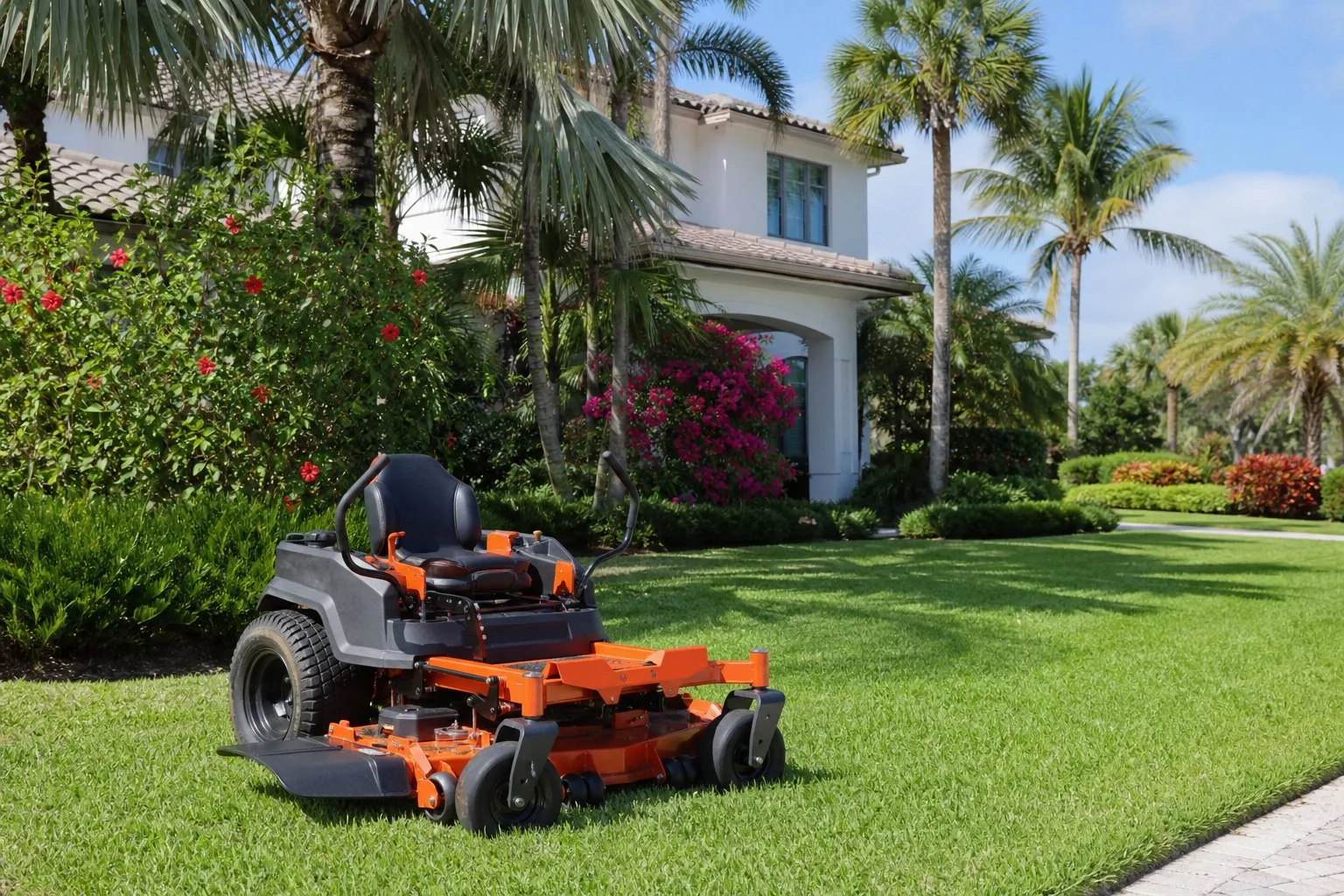
Why Sarasota lawns need a specific approach
Sarasota County is operating under a Modified Phase III "Extreme" Water Shortage order, extended through October 1, 2026, which limits irrigation to once per week. That single constraint changes how a lawn must be managed. There is no longer any option to compensate for shallow roots, a scalped mowing height, or a poorly adjusted irrigation system by simply watering more often. Everything else has to be right instead.
The good news is that the region’s dominant turf is well suited to it. University of Florida IFAS Extension describes St. Augustinegrass as producing a green to blue-green dense turf that is well adapted to most soils and climatic regions in Florida, with relatively good salt tolerance and, in certain cultivars, better shade tolerance than other warm-season grass species. Salt tolerance matters on a coast where sea air and brackish influence are part of the environment, and shade tolerance matters under mature live oaks.
Mowing — the highest-value thing you control
Mowing height is the most consequential lawn decision most homeowners make, and it is the one most often wrong. UF/IFAS guidance for standard St. Augustinegrass cultivars — BitterBlue, Classic, Floratam and similar — mowed with a rotary mower is to maintain a height of 3.5 to 4 inches.
That is considerably taller than most lawns are cut. Taller grass shades its own root zone, holds soil moisture longer between irrigation events, competes far better against weeds, and supports a deeper root system. On a once-a-week watering allowance, height is one of the few genuine levers available.
Frequency follows from the same source: no more than one-third of the leaf blades should be removed at any mowing. Cutting more than that at once stresses the plant, forces it to spend reserves regrowing leaf instead of root, and produces the yellow, ragged appearance that follows an overdue cut. In the wet season, when growth is fastest, this often means mowing more often rather than cutting lower.
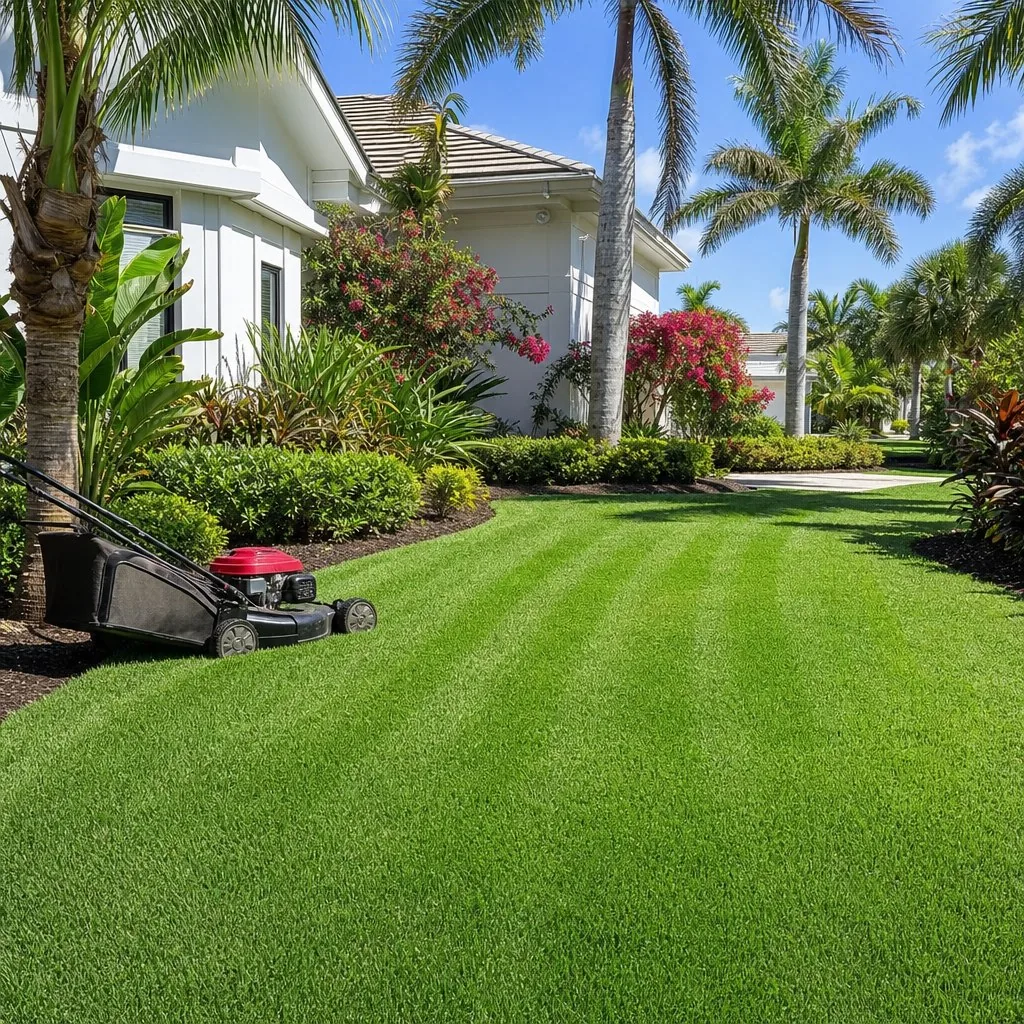
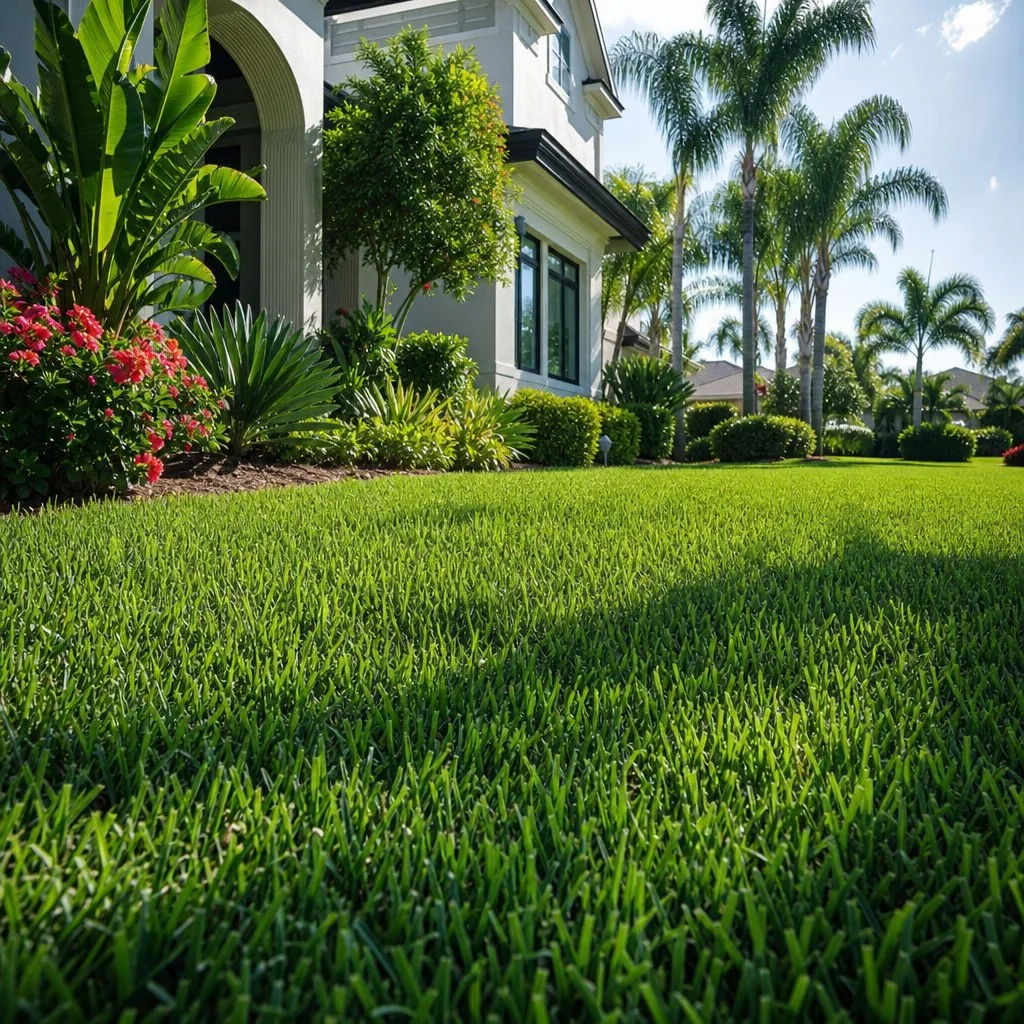
Watering within a once-a-week restriction
Under the current order, irrigation is limited to one day per week assigned by the last digit of the property address, and for sites under one acre it may only be done between 12 a.m. and 4 a.m., or between 8 p.m. and 11:59 p.m., on that assigned day.
Because there is only one opportunity each week, depth matters more than ever. UF/IFAS guidance is to apply one-half to three-quarters of an inch of water per irrigation application. Applying that amount properly wets the root zone and encourages roots downward; applying a light sprinkle produces shallow roots and a lawn that wilts within days.
Knowing what your system actually delivers is therefore worth establishing rather than assuming. A simple catch-can check across a zone — straight-sided containers set out during a cycle — tells you how long that zone must run to deliver half to three-quarters of an inch. Most people are surprised in one direction or the other.
What our lawn care covers
Mowing at the correct height. Cut to the height the grass should be maintained at, on a frequency that respects the one-third rule, with sharp blades — dull blades tear leaf tissue and leave a whitish, frayed edge that invites disease.
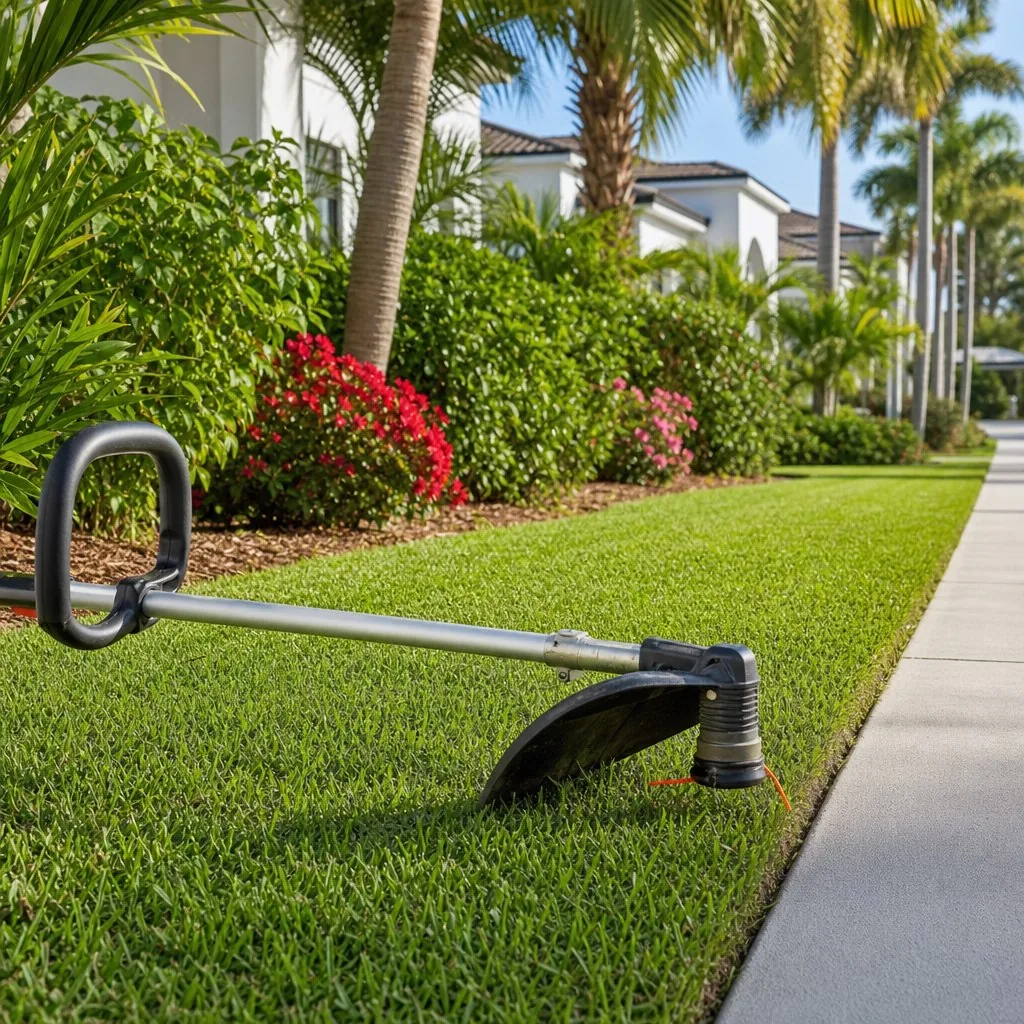
Edging and detailing. Clean edges along drives, walks, and beds, with clippings blown off hard surfaces rather than left to wash into the storm system.
Condition monitoring. Warm-season lawns in a humid climate develop problems quickly. Catching a developing pest or disease issue while it is a patch rather than a section is largely a matter of someone competent looking at the lawn every week.
Irrigation observation. Noticing dry arcs, misaligned heads, or zones that clearly are not delivering, which matters acutely when there is only one watering day to get right.
From property walk to service details: Budget Inputs for Lawn Decisions
Cost depends on lot size and the amount of actual turf, how much edging and detail work the property needs, obstacles and access, and visit frequency. Regular service is priced differently from an overgrown reset, and a property that has been left long enough to need reclamation before routine care can begin will reflect that. We quote after seeing the property.
Timeline and rhythm
Routine visits are typically weekly or fortnightly, adjusted to the season — growth through the warm wet months is far faster than in the cooler part of the year, and the one-third rule means frequency should follow growth rather than a fixed calendar.
From property walk to service details: guide for Lawn Decisions
Regular maintenance is worth most where a lawn is already in reasonable condition, since consistency is what keeps it that way. Where a lawn has thinned badly, been scalped repeatedly, or lost coverage to pests or shade, the honest answer is that mowing alone will not recover it — the underlying cause needs addressing first, and in some cases re-establishment is the realistic route. We will say which of those we think you are looking at.
Local constraint: the current water shortage order
Sarasota County is under a Modified Phase III "Extreme" Water Shortage order, extended through October 1, 2026. Irrigation is limited to once per week, assigned by the last digit of the address: 0 and 1 on Monday, 2 and 3 on Tuesday, 4 and 5 on Wednesday, 6 and 7 on Thursday, and 8 and 9 on Friday. For sites under one acre, watering on the assigned day is permitted only between 12 a.m. and 4 a.m. or between 8 p.m. and 11:59 p.m. Managing a lawn well under this order is mostly a matter of correct mowing height and delivering a proper depth of water on the one day available. (Sources: Southwest Florida Water Management District / Sarasota County; UF/IFAS Extension ENH5/LH010.)
Frequently asked questions
How tall should my St. Augustine lawn be cut? UF/IFAS guidance for standard cultivars mowed with a rotary mower is 3.5 to 4 inches — taller than most lawns are cut, and a significant advantage under watering restrictions.
How often can I water? Once per week under the current order, on the day assigned by your address’s last digit, and for sites under an acre only between 12 a.m. and 4 a.m. or 8 p.m. and 11:59 p.m.
How much water should I apply? UF/IFAS guidance is one-half to three-quarters of an inch per irrigation application. It is worth measuring what your system actually delivers rather than estimating.
Why does my lawn look yellow after mowing? Usually because too much was removed at once. No more than one-third of the leaf blades should be taken at any mowing; the answer is to mow more often, not lower.
Will St. Augustine grow in shade? Certain cultivars have better shade tolerance than other warm-season species, so cultivar choice matters under mature tree cover.
Does salt air affect my lawn? St. Augustinegrass has relatively good salt tolerance, which is part of why it is so widely used in this coastal region.
Sources
Southwest Florida Water Management District — district water restrictions: swfwmd.state.fl.us. UF/IFAS Extension — St. Augustinegrass for Florida Lawns (ENH5/LH010): edis.ifas.ufl.edu/lh010.
Get a free quote for lawn care in Sarasota →
From property walk to written acceptance
- Review Before CommitmentThe property review and estimate do not require the owner to proceed with the project.
- Walkthrough to Written ScopeObserved conditions, included work, and price are written down before a schedule is accepted.
Get a Free Quote
Describe the Sarasota site, its water movement, and the intended outdoor use.
Define the Sarasota Property Objective
Share the drainage, growth, access, and outdoor-living priorities so the Gulf Coast work area and outcome can be documented.
Get a Free QuoteFrequently Asked Questions
How short should a St. Augustine lawn be cut in Sarasota?
Higher than most people expect. Standard cultivars, including Bitterblue, Classic and Floratam, should be maintained at three and a half to four inches with a rotary mower, and dwarf cultivars at two to two and a half inches. Cutting lower than that repeatedly increases stress on the lawn, discourages deep rooting and raises the chance of scalping if a mow is delayed by weather. Source: UF/IFAS Extension ENH5/LH010.
How much of the blade should come off in one cut?
No more than a third of the leaf blade in any single mowing. Mowing height should also be raised during periods of moisture stress or where the grass is growing in shade. Under a one-day-per-week watering schedule a deeper root system is what carries the lawn between cycles, and repeated low cutting works directly against that. Source: UF/IFAS Extension ENH5/LH010.
Which day can the lawn be watered?
One day a week, set by the last digit of the street address: 0 or 1 Monday, 2 or 3 Tuesday, 4 or 5 Wednesday, 6 or 7 Thursday, 8 or 9 Friday. Permitted hours are 12:01 a.m. to 4 a.m. or 8 p.m. to 11:59 p.m., and a property under one acre may use only one of those windows. These are SWFWMD's Modified Phase III restrictions, extended through 1 October 2026 and covering all of Sarasota County. Source: SWFWMD, checked 3 August 2026.
When does a lawn actually need water?
When the leaf blades begin to fold up, wilt or turn a blue-gray colour, or when footprints stay visible after walking across the grass. The application to aim at is half to three-quarters of an inch, which reaches roughly the top eight inches of soil where most of the roots are. Frequency changes with the season; the amount applied does not. Source: UF/IFAS Extension ENH5/LH010.
Why would a lawn yellow while it is being watered?
Yellowing is not always a water problem. On soils above pH 7.0, or where the irrigation water itself is high-pH, yellow leaf blades may indicate an iron or manganese deficiency, which soluble or chelated micronutrients can correct. The southern chinch bug is also the major insect pest of the species and shows first as yellowish to brownish patches in full sun near paving and walls. Both are worth ruling out before more water. Source: UF/IFAS Extension ENH5/LH010.
What should a written lawn care scope name?
It should name the areas being cut and their measurements, the cultivar in the ground and the height it is being maintained at, what happens to clippings, edging and trimming included, the visit frequency, and anything excluded. Naming the mowing height matters here, because a lawn cut at a single default height regardless of cultivar is the most common avoidable stress on a Sarasota lawn.