
Irrigation Systems in Sarasota, FL
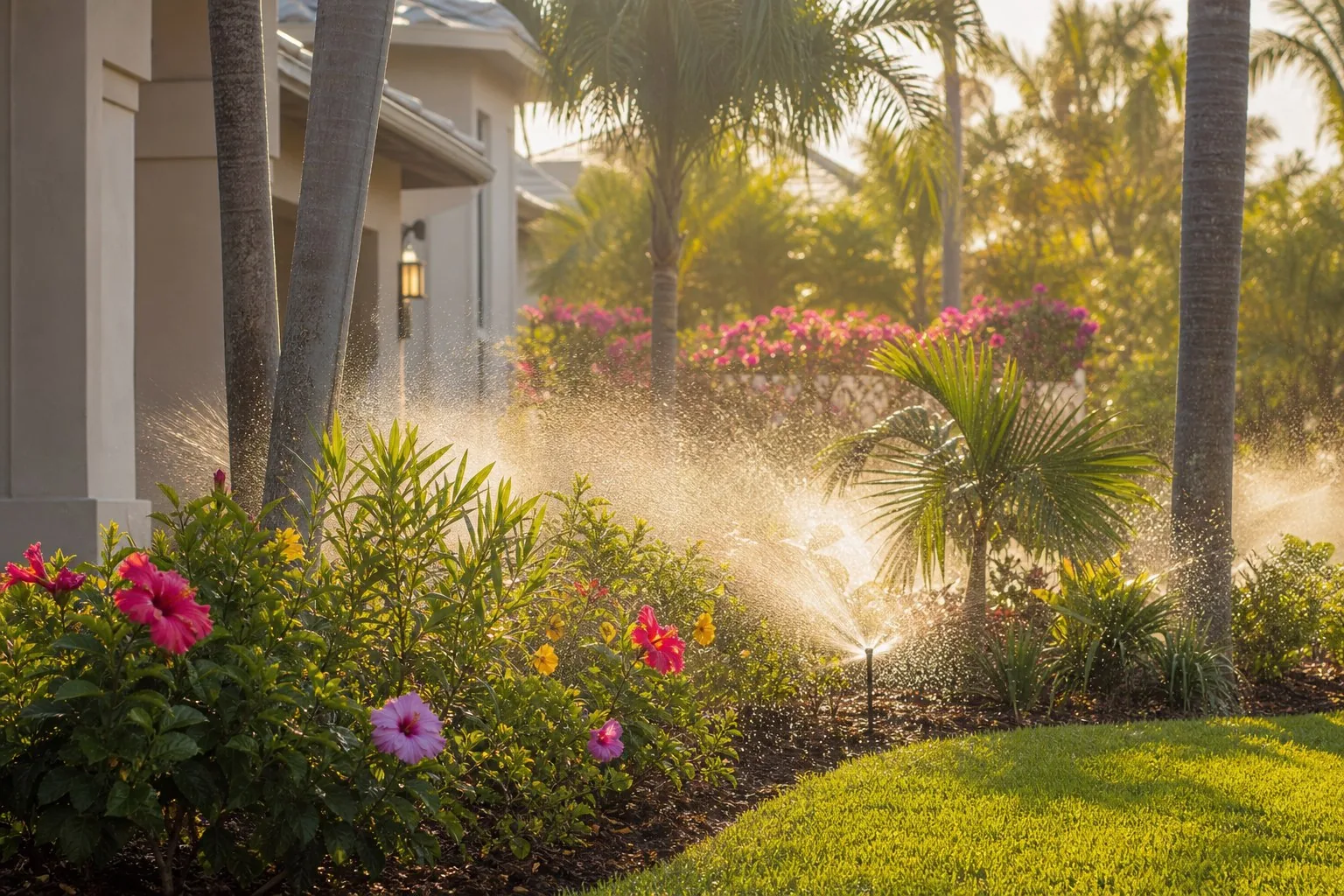
An irrigation system in Sarasota now has one job to do well: deliver the right depth of water, evenly, on a single permitted day each week, inside a narrow overnight or late-evening window. Under the current water shortage order there is no margin for uneven coverage or a system that has drifted out of adjustment — whatever a zone fails to deliver on its assigned day cannot be made up until the following week.
Why system condition matters more than usual right now
Sarasota County is operating under a Modified Phase III "Extreme" Water Shortage order, extended through October 1, 2026. Irrigation is limited to once per week, on a day assigned by the last digit of the property address, and for sites under one acre it is permitted only between 12 a.m. and 4 a.m. or between 8 p.m. and 11:59 p.m. on that day.
Under weekly watering, the usual workaround for a poor system — run it more often — is unavailable. Uneven coverage stops being a minor inefficiency and becomes the reason parts of a lawn decline. A misaligned head, a clogged nozzle, a zone with mismatched heads, or a controller programmed to the wrong day now produces a visible result within a fortnight.
The restricted hours have a second consequence worth naming: almost all watering happens while you are asleep. Faults that would be obvious in daylight go unseen for weeks. Systems here need to be actively checked, because nobody is watching them run.
From property walk to service details: guide for Property Planning
Document the Sarasota irrigation connection and applicable backflow protection before commissioning.
Zoning by need. Turf, beds, and trees have genuinely different requirements and belong on separate zones, as do sunny and shaded areas. Zoning is where efficiency is either designed in or designed out.
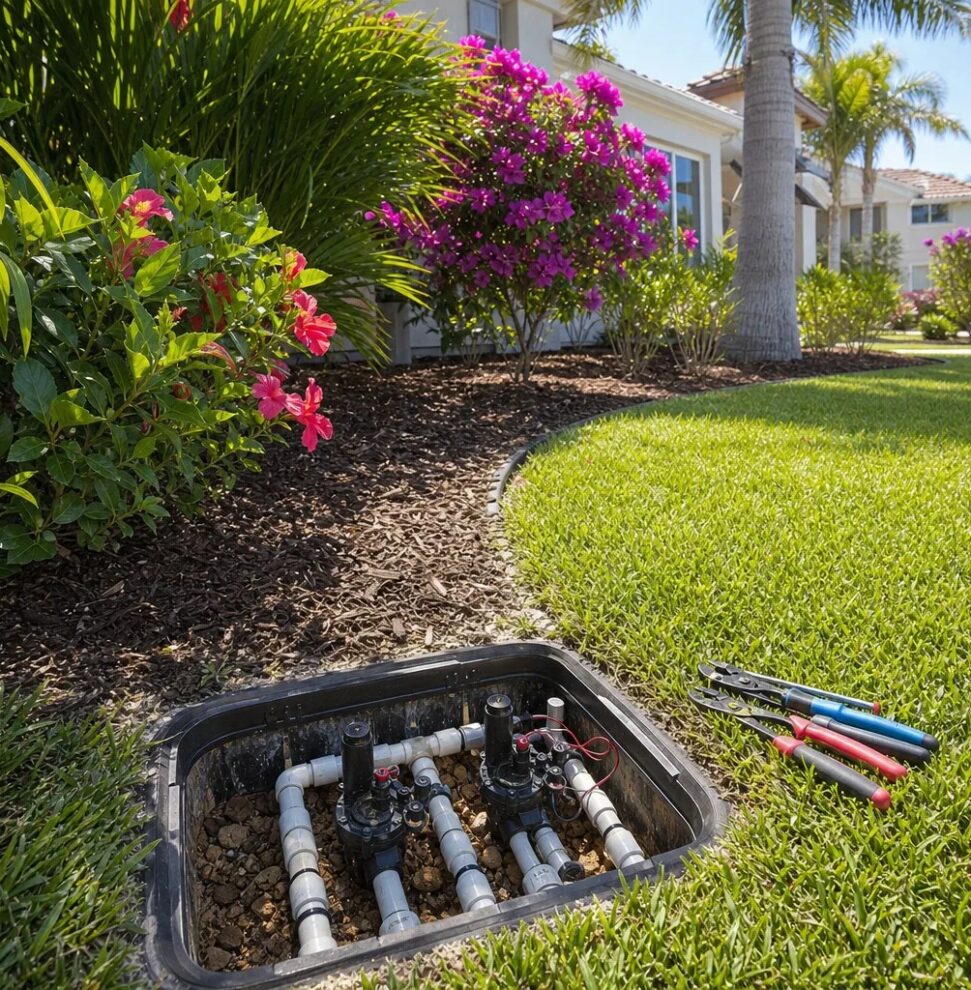
Matched precipitation within a zone. Every head on a zone should apply water at a comparable rate. Mixing head types on one zone means the run time is always wrong for some part of it — a fault that is invisible on paper and obvious on the lawn.
Correct spacing and alignment. Heads are spaced for head-to-head coverage so patterns overlap properly rather than leaving dry arcs that get compensated for with longer run times.
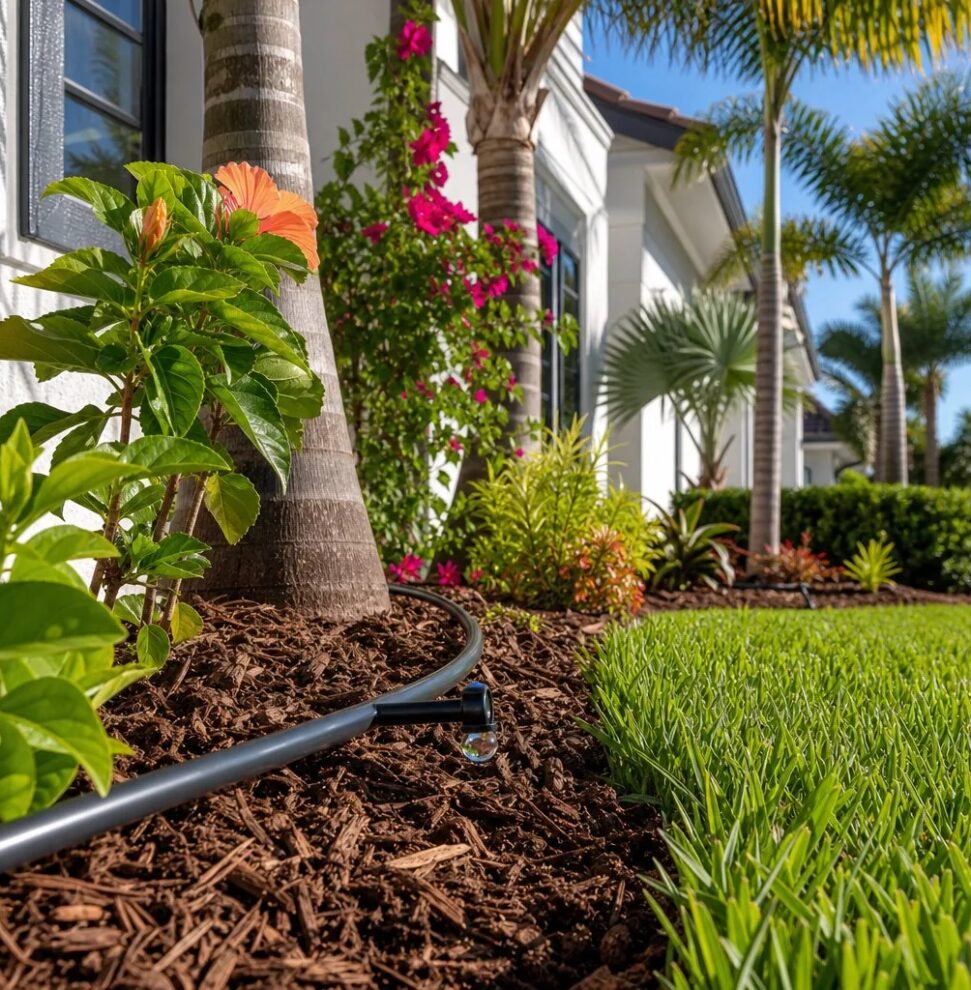
Drip for beds. Planting beds are far better served by drip than by spray: water goes to the root zone, nothing is lost to evaporation, and there is no overspray onto walks and drives.
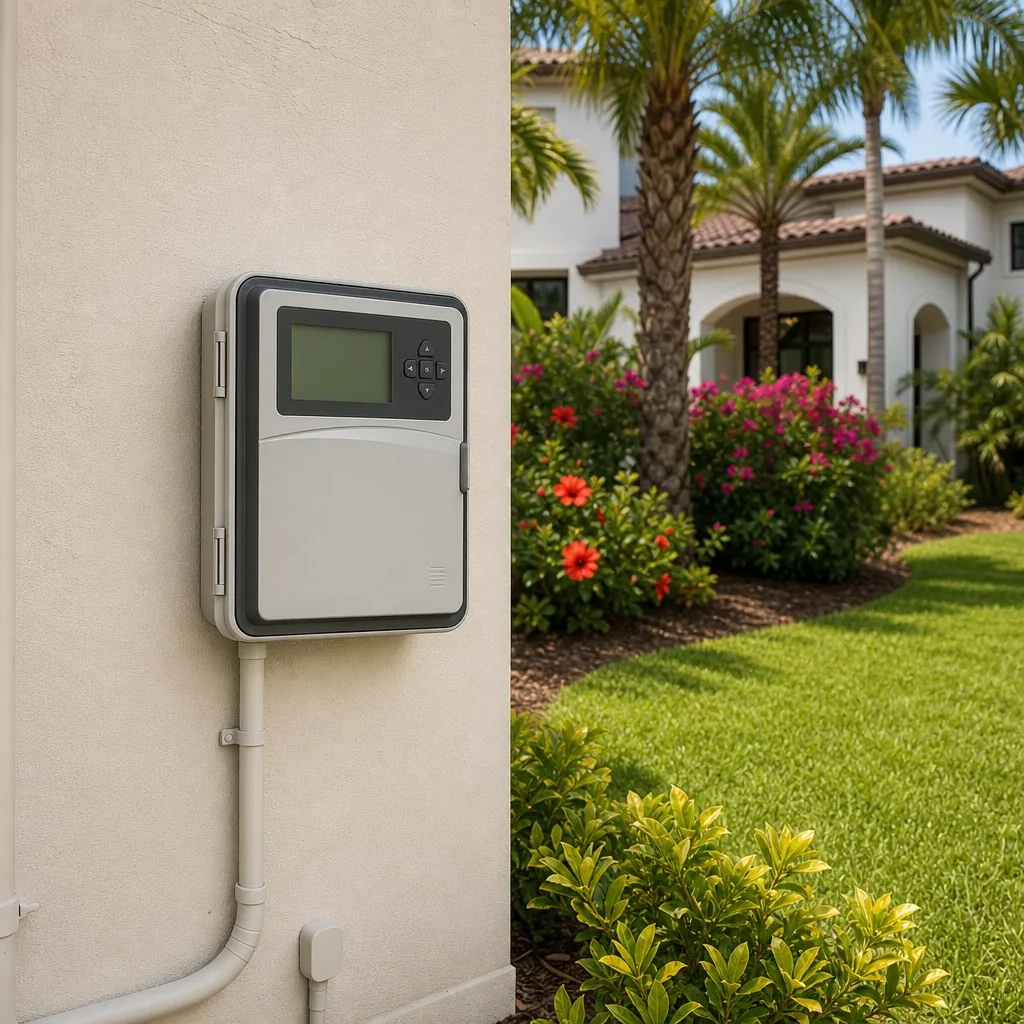
A controller set correctly. The controller must be programmed to the correct assigned day and permitted hours, and adjusted seasonally rather than left on one schedule year-round.
Rain shut-off. A functioning rain sensor or shut-off device prevents the system running during and after the heavy rain this region receives in the wet season.
From property walk to service details: guide for Property Planning
With one watering day, depth is everything. UF/IFAS guidance is to apply one-half to three-quarters of an inch of water per irrigation application. Delivering that properly wets the root zone and encourages deeper rooting; a light application produces shallow roots and a lawn that struggles between weekly cycles.
The only reliable way to know what a zone delivers is to measure it. Straight-sided containers placed across a zone during a cycle show both the depth applied and how evenly it lands. That single check frequently explains a problem that has been blamed on soil, grass, or fertiliser for years.
On sandy soils, which drain quickly, applying the full amount in one uninterrupted run is usually appropriate; where water begins to pool or run, splitting the application into shorter cycles within the permitted window lets it soak in instead.
From property walk to service details: Budget Inputs for Property Planning
Cost depends on property size, the number of zones, head count and type, whether this is a new installation, a repair, or a redesign, and what controller, backflow, and rain shut-off provisions are required. Repairs and zone-level corrections are naturally far less than a full system. Trenching adds labour. We assess and quote on site, since zone count alone can change the scope substantially.
Timeline
Repairs and adjustments are usually completed in a single visit. A new system or significant redesign typically takes a few days depending on zone count and trenching. Commissioning is part of the job: every zone is run, coverage checked, heads adjusted, and the controller programmed to your assigned day and permitted hours before we leave.
From property walk to service details: guide for Property Planning
If parts of your lawn are declining while others look fine, if you have never verified what your system actually delivers, or if it has not been checked in several seasons, an assessment is worth far more than a longer run time. Many properties do not need a new system — they need heads aligned or replaced, mismatched zones corrected, beds moved to drip, a rain sensor restored, and the controller set to the right day, hours, and depth. That combination usually captures most of the available improvement.
Local constraint: the current water shortage order
Sarasota County is under a Modified Phase III "Extreme" Water Shortage order, extended through October 1, 2026. Irrigation is limited to once per week by address last digit — 0 and 1 Monday, 2 and 3 Tuesday, 4 and 5 Wednesday, 6 and 7 Thursday, 8 and 9 Friday — and for sites under one acre only between 12 a.m. and 4 a.m. or between 8 p.m. and 11:59 p.m. on the assigned day. Programming the controller correctly is the first thing we check on any system here. (Sources: Southwest Florida Water Management District / Sarasota County; UF/IFAS Extension ENH5/LH010.)
Frequently asked questions
Which day can I water? The day assigned to the last digit of your address: 0 and 1 Monday, 2 and 3 Tuesday, 4 and 5 Wednesday, 6 and 7 Thursday, 8 and 9 Friday.
What hours are allowed? For sites under one acre, between 12 a.m. and 4 a.m. or between 8 p.m. and 11:59 p.m. on the assigned day.
How much should each cycle deliver? UF/IFAS guidance is one-half to three-quarters of an inch per application. Measuring with catch cans is the only way to know what your system actually does.
Can you repair a system you did not install? Yes. Repairs, head replacement, zone corrections, and controller reprogramming are routine regardless of who installed it.
Why is part of my lawn dying when the system runs every week? Almost always uneven coverage — misaligned heads, mismatched head types on one zone, or pressure problems. With only one watering day, an underperforming area has no chance to recover.
Do I need a rain sensor? A working rain shut-off is important here, where heavy wet-season rainfall can otherwise be followed by a full irrigation cycle overnight.
Sources
Southwest Florida Water Management District — district water restrictions: swfwmd.state.fl.us. UF/IFAS Extension — St. Augustinegrass for Florida Lawns (ENH5/LH010): edis.ifas.ufl.edu/lh010.
Get a free quote for irrigation work in Sarasota →
From property walk to written acceptance
- Review Before CommitmentThe property review and estimate do not require the owner to proceed with the project.
- Walkthrough to Written ScopeObserved conditions, included work, and price are written down before a schedule is accepted.
Get a Free Quote
Describe the Sarasota site, its water movement, and the intended outdoor use.
Define the Sarasota Property Objective
Share the drainage, growth, access, and outdoor-living priorities so the Gulf Coast work area and outcome can be documented.
Get a Free QuoteFrequently Asked Questions
Which day and hours can an irrigation system run in Sarasota County?
Lawn and landscape watering is limited to one day per week under SWFWMD's Modified Phase III order, extended through 1 October 2026. The day comes from the last digit of the street address: 0 or 1 Monday, 2 or 3 Tuesday, 4 or 5 Wednesday, 6 or 7 Thursday, 8 or 9 Friday. Permitted hours are 12:01 a.m. to 4 a.m. or 8 p.m. to 11:59 p.m., and a property under one acre may use only one of those two windows. City or county rules come first where they are stricter. Source: SWFWMD, checked 3 August 2026.
How much water does one weekly cycle actually have to deliver?
UF/IFAS puts an established lawn at half to three-quarters of an inch per application, which wets roughly the top eight inches of soil where most of the roots sit. Under a one-day rule that full amount has to land inside a single permitted window rather than being spread across the week, so run times are calculated from the zone's measured output instead of a default schedule. Source: UF/IFAS Extension ENH5/LH010.
How can a homeowner measure what a zone delivers?
Put several straight-sided cans across the zone, run it, and time how long it takes to fill them to the half-inch or three-quarter-inch mark. Each zone will take a different length of time, which is why one run time programmed across a whole controller leaves some areas dry and others using water the property is not permitted to use. Wide variation between cans inside a single zone points to a coverage fault. Source: UF/IFAS Extension ENH5/LH010.
Can beds and shrubs still be watered on other days?
Yes. Hand watering and microirrigation of flower beds, shrubs and plant material other than lawn are permitted on any day under the current restrictions, but only before 8 a.m. or after 6 p.m. Separating thirsty ornamental planting onto microirrigation, rather than leaving it dependent on a lawn zone, is what keeps those beds serviceable during a shortage order. Source: SWFWMD, checked 3 August 2026.
What happens to irrigation while a new lawn is establishing?
New lawns and plants have a sixty-day establishment period. On days 1 to 30 they may be watered any day of the week. On days 31 to 60 they may be watered three days a week, even-numbered addresses Tuesday, Thursday and Sunday and odd-numbered addresses Monday, Wednesday and Saturday. A written schedule of that establishment watering has to be kept by the user. Source: SWFWMD, checked 3 August 2026.
What should a written irrigation scope name?
It should name the zones being worked and what each one covers, the head or emitter types being installed, the measured output the run times are based on, which assigned watering day and permitted window the controller is programmed to, and what is excluded. Those details are what make two irrigation quotes comparable, because a lower total often reflects a smaller scope rather than a better price.