
Landscape Design in Sarasota, FL
Landscape design decides what goes where, why, and how it will be maintained — before anything is planted or built. In Sarasota a good design has to answer to a subtropical climate, sandy soils, coastal exposure, intense wet-season rainfall, and an irrigation allowance currently limited to one day a week. Designs that ignore any of those look excellent on paper and disappoint within two seasons.
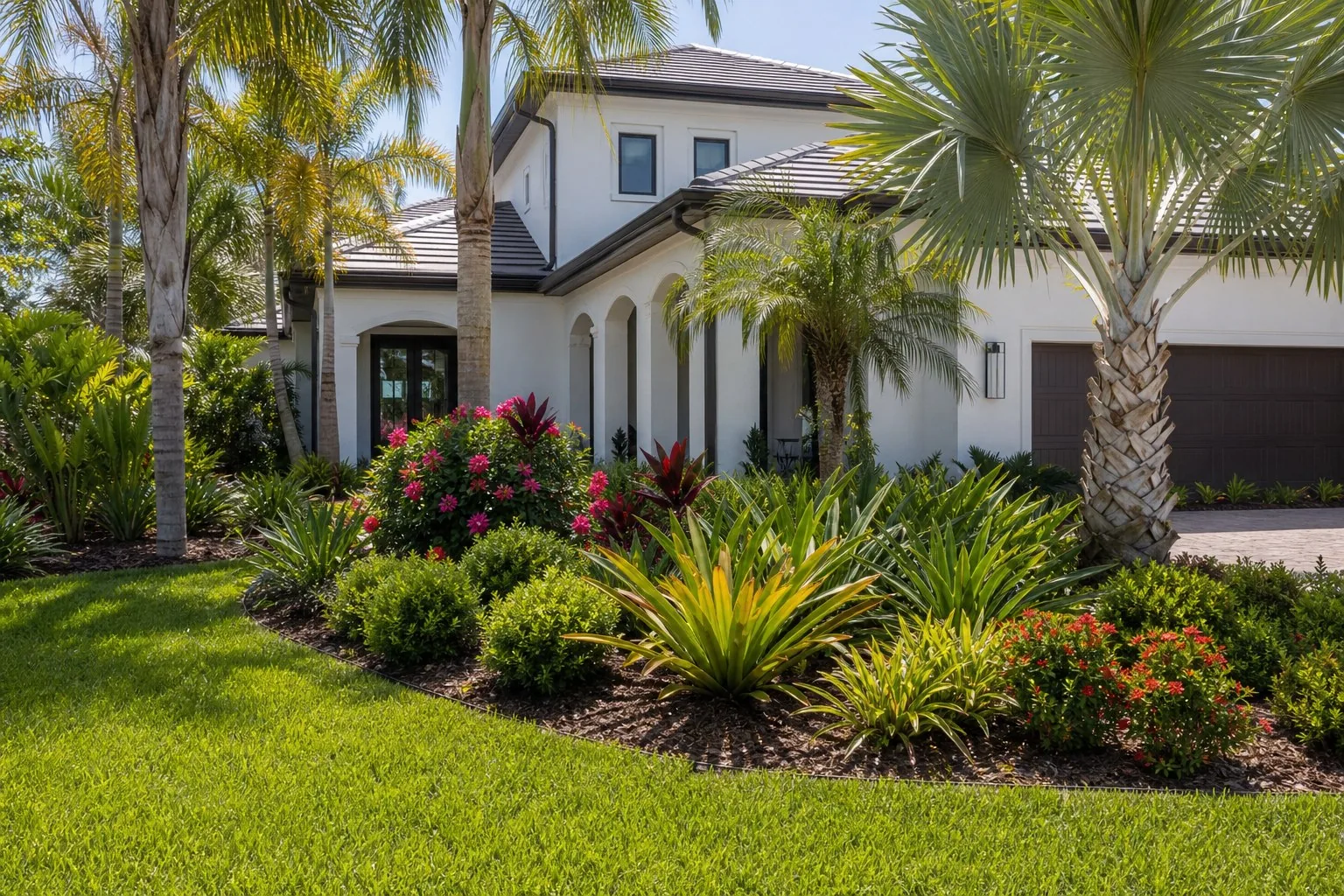
Why design matters here
Most disappointing landscapes in this region are not badly built. They are badly matched — to the light, to the drainage, to the salt exposure, or to the amount of water that can lawfully be applied to them. Design is where those constraints get resolved cheaply, on paper, instead of expensively, in the ground.
The current water shortage order makes this sharper than usual. Sarasota County is under a Modified Phase III "Extreme" Water Shortage order extended through October 1, 2026, limiting irrigation to once per week. A design that assumes generous watering is not a design that can be delivered. Grouping plants by water need, sizing turf areas deliberately, and choosing species that will hold up on a weekly cycle are design decisions, not maintenance decisions.
What the design process covers
Site assessment. Sun and shade through the day, drainage and low points, existing trees and their root zones, exposure to salt air and wind, soil conditions, and how water actually moves across the property during heavy rain.
How you use the space. Where people sit, where children or dogs play, what needs screening, what should be visible from inside the house, and where you walk between things. Design that ignores circulation produces beds with paths worn through them.
Hydrozoning. Plants are grouped by water requirement so each irrigation zone can be run correctly. Mixing a thirsty planting with a drought-tolerant one on a single zone means one of them is always watered wrongly — a design error that no amount of maintenance can correct later.
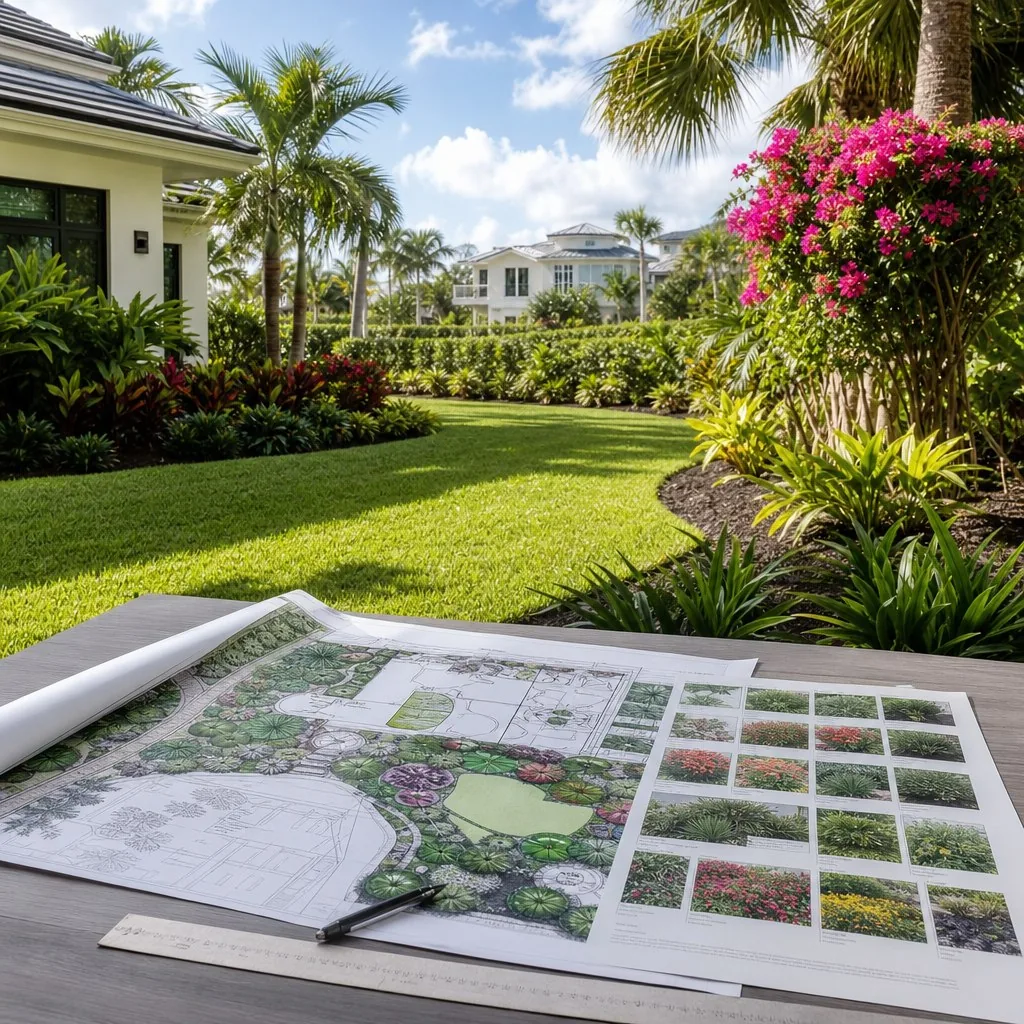
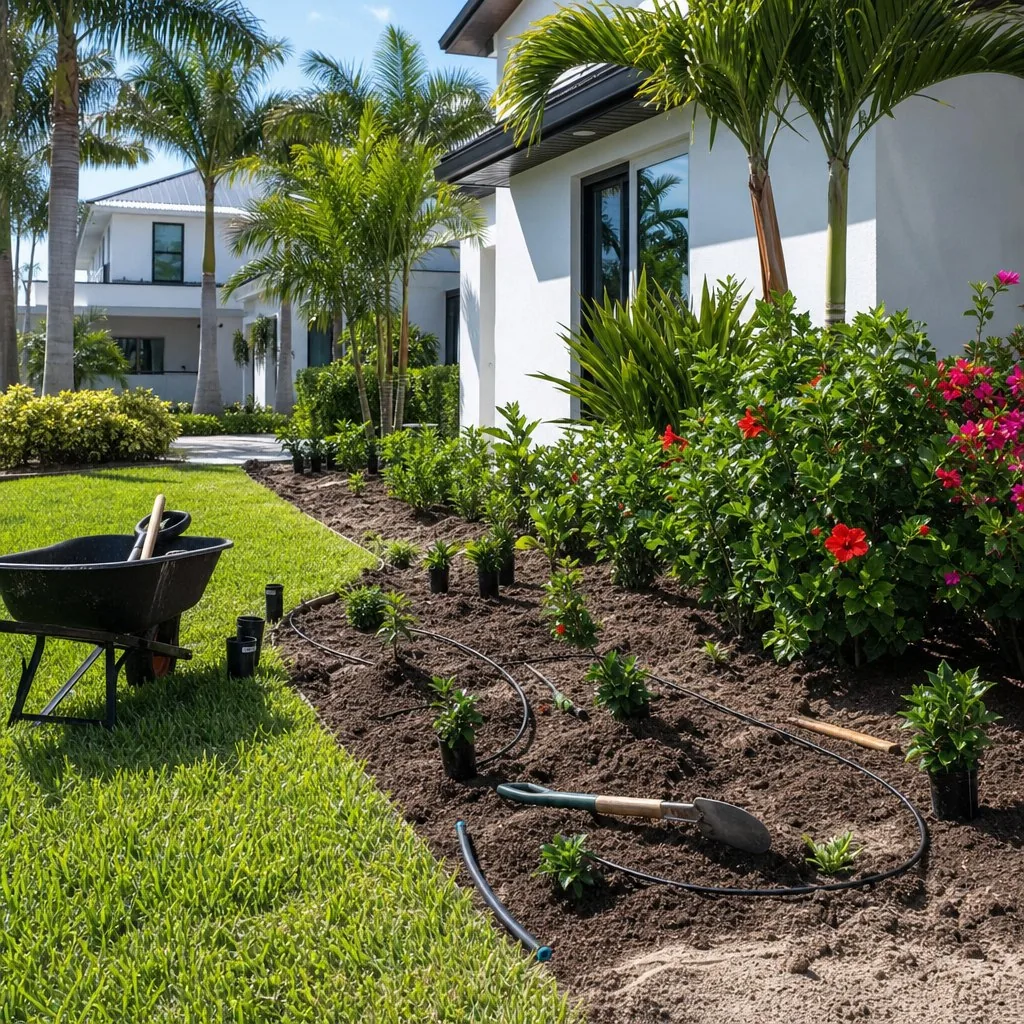
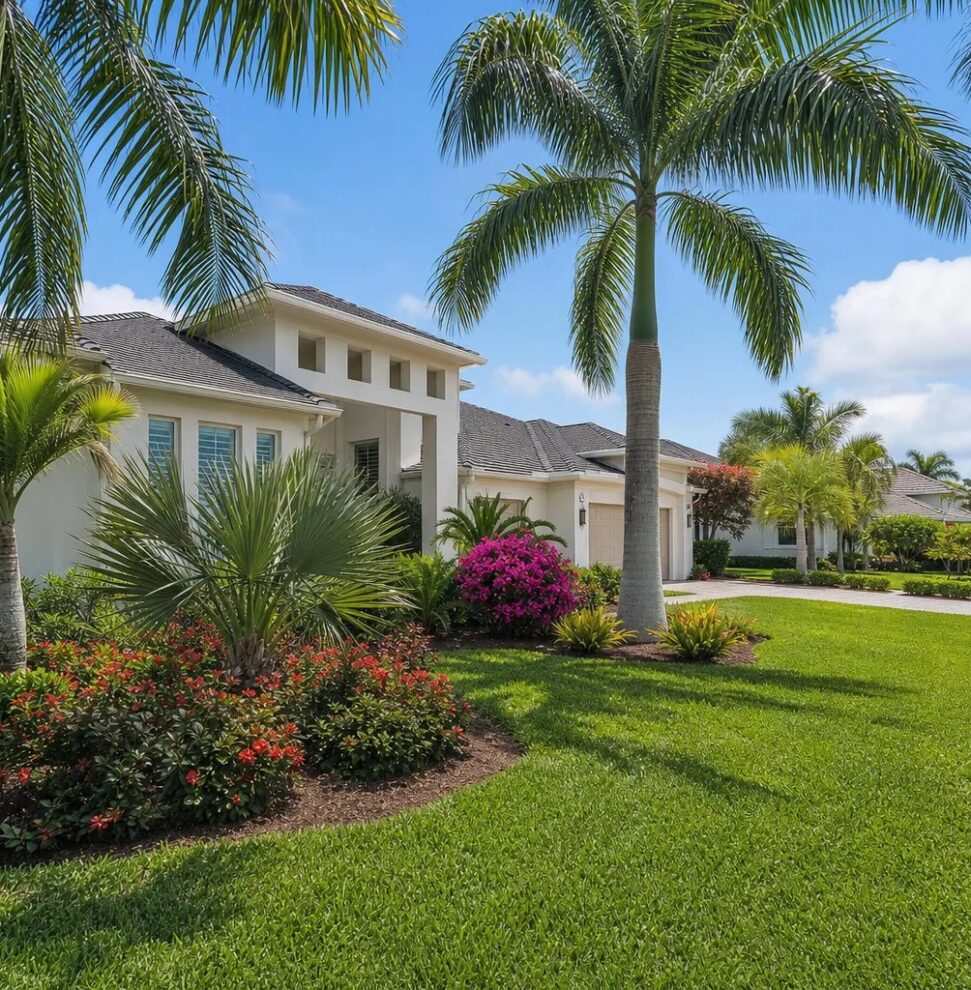
Turf sized on purpose. Lawn is placed where it is genuinely used and kept out of the deep shade, narrow strips, and awkward corners where it never performs. Where turf is retained, cultivar selection follows the conditions: UF/IFAS notes that certain St. Augustinegrass cultivars have better shade tolerance than other warm-season grass species, and that St. Augustinegrass has relatively good salt tolerance and is well adapted to most soils and climatic regions in Florida.
Drainage and grading. Wet-season rainfall arrives in volume. Deciding where water goes is a design responsibility, not something to be discovered afterwards.
Hardscape and structure. Patios, walkways, edging, and beds establish the framework that planting then fills. Getting the structure right is what makes a landscape read as designed rather than accumulated.
Planting plan. Layered, with canopy and structure carrying the composition year-round rather than relying on seasonal colour to do the work.
Designing for shade and for coast
Two conditions dominate site planning in this area. Mature canopy creates deep shade where turf will not thrive regardless of care — a design should either select for it or stop trying to grow grass there and use planting, ground cover, or hardscape instead. Coastal exposure brings salt in the air and wind, and plant selection has to account for it; the salt tolerance that makes St. Augustinegrass so widely used here is exactly the kind of attribute worth designing around rather than discovering.
From property walk to service details: Budget Inputs for Property Planning
Design cost depends on property size, how complex the site is, and how far the plan goes — a planting plan for one area is a different piece of work from a full property design with hardscape, drainage, and irrigation layout. Installation is quoted separately and is driven by scope, materials, access, and how much removal and grading is required. Designing first generally reduces total cost, because it prevents building the wrong thing well. We discuss scope on site.
Timeline
Design runs from an initial site visit and brief through to a plan you can build from, with revision in between; the elapsed time depends mainly on scope and how quickly decisions are made. Installation is then scheduled and can be phased across seasons, which is often the practical route for a larger property and spreads cost as well as disruption.
From property walk to service details: guide for Property Planning
Design is worth commissioning when the property is being reworked substantially, when previous attempts have failed and nobody is sure why, when drainage or shade problems keep recurring, or when a large project is going to be built in stages and needs a coherent plan to build toward. For a single small bed, it is usually unnecessary. For anything that involves changing grade, hardscape, or irrigation layout, designing first is materially cheaper than correcting later.
Local constraint: designing for a once-a-week allowance
Sarasota County is under a Modified Phase III "Extreme" Water Shortage order, extended through October 1, 2026. Irrigation is limited to once per week by the last digit of the address — 0 and 1 Monday, 2 and 3 Tuesday, 4 and 5 Wednesday, 6 and 7 Thursday, 8 and 9 Friday — and for sites under one acre only between 12 a.m. and 4 a.m. or between 8 p.m. and 11:59 p.m. on the assigned day. A design produced for this region has to work within that, which means hydrozoning, deliberate turf sizing, and species selected to hold up on a weekly cycle. (Sources: Southwest Florida Water Management District / Sarasota County; UF/IFAS Extension ENH5/LH010.)
Frequently asked questions
Do I need a design, or can you just plant? For a small bed, planting directly is fine. For anything involving grade, drainage, hardscape, or irrigation layout, designing first avoids building the wrong thing well.
Can a landscape still look lush under a once-a-week restriction? Yes — by grouping plants by water need, sizing turf deliberately, and selecting species suited to the conditions. What does not work is a design that assumes unlimited watering.
Grass will not grow under my trees. What are the options? Either select a cultivar with better shade tolerance, since certain St. Augustinegrass cultivars handle shade better than other warm-season grasses, or stop growing turf there and design planting, ground cover, or hardscape instead.
Does salt air limit what I can plant? It shapes the palette, particularly nearer the water. It is a design input rather than an obstacle.
Can the work be phased? Yes, and for larger properties it is often the sensible route. A coherent plan is what makes phasing work rather than producing a yard assembled in disconnected pieces.
What about drainage in heavy rain? Deciding where water goes is part of the design. Retrofitting drainage after hardscape and planting are in place is considerably more expensive.
Sources
Southwest Florida Water Management District — district water restrictions: swfwmd.state.fl.us. UF/IFAS Extension — St. Augustinegrass for Florida Lawns (ENH5/LH010): edis.ifas.ufl.edu/lh010.
Get a free quote for landscape design in Sarasota →
From property walk to written acceptance
- Review Before CommitmentThe property review and estimate do not require the owner to proceed with the project.
- Walkthrough to Written ScopeObserved conditions, included work, and price are written down before a schedule is accepted.
Get a Free Quote
Describe the Sarasota site, its water movement, and the intended outdoor use.
Define the Sarasota Property Objective
Share the drainage, growth, access, and outdoor-living priorities so the Gulf Coast work area and outcome can be documented.
Get a Free QuoteFrequently Asked Questions
What does a coastal site change about plant selection?
Salt is the constraint that separates a Sarasota planting plan from an inland one. St. Augustinegrass has relatively good salt tolerance, which is part of why it is the most commonly used lawn grass in Florida and suits a coastal county. Sun exposure across each area of the property drives the rest of the palette, because cultivar shade tolerance varies and Floratam does not persist below about six hours of sun a day. Source: UF/IFAS Extension ENH5/LH010.
How does a one-day-per-week watering rule shape a design?
It decides how planting is grouped. Sarasota County is limited to one watering day per week under SWFWMD's Modified Phase III order through 1 October 2026, with hours of 12:01 a.m. to 4 a.m. or 8 p.m. to 11:59 p.m. and only one of those windows for a property under an acre. Mixing a thirsty planting and a drought-tolerant one on a single zone means one of them is watered wrongly every cycle. Source: SWFWMD, checked 3 August 2026.
Are beds treated differently from lawn?
Yes, and it is a useful design lever. Hand watering and microirrigation of flower beds, shrubs and plant material other than lawn are permitted on any day under the current restrictions, but only before 8 a.m. or after 6 p.m. Putting ornamental planting on microirrigation rather than on a lawn zone keeps those beds serviceable inside the restriction instead of competing for the lawn's single window. Source: SWFWMD, checked 3 August 2026.
Should the soil be tested before a planting plan is written?
Before, rather than after. A soil test for pH and salinity belongs ahead of planting, or at the point of buying a house with an existing lawn. On a coastal sand site those two readings decide what will hold. A newly planted area on sand with little organic matter also has a different feeding requirement from a bed that has been fertilised for years. Source: UF/IFAS Extension ENH5/LH010.
Can a community association require a planting that needs more water?
No. Under the current order no homeowners association or other entity may enforce deed restrictions or community standards requiring an increase in potable or domestic well water use, including replacement of plant material to meet aesthetic standards. If a design is being shaped to satisfy a community standard that would need more water than the district permits, that conflict belongs on the page before anything is planted. Source: SWFWMD, checked 3 August 2026.
What should a design finished result contain?
A measured site plan, a planting palette with species named rather than described, a materials schedule, the irrigation zoning the planting assumes, and a phasing order so the build can be priced and staged rather than committed to all at once. Naming the assigned watering day the zoning is built around is what ties the drawing to what the property is actually permitted to do.